When I go see a film, when I leave the theater... I like to be happier than I was when when I went in, I like to leave with an up feeling, and I like a picture to have a sense of substance, to be about life and the things that matter to me.
And after seeing this movie one more time, I'm thinking of something my ninth grade World History teacher said to me as I was saying sorry to someone about my appreciation of a certain book or song...
Never apologize to anyone for liking something.
And with that in mind, here's my modest review of the film Penelope.
 (from www.wildaboutmovies.com)
This story is about a girl born to a blue blood, upper class family. 5 generations before her due date, a great-great-great-great grandfather had an affair with a servant girl. His family talked him out of marrying her and she killed herself. Well, he screwed with the wrong commoner, because the young woman's mother happened to be a witch who cursed the family... the next girl born to this line would have the face of a pig and it would stay that way until one of her own kind accepts her as she is "til death do us part." And so Penelope was born and her mother consciously avoided the public ever seeing her. She went through great lengths (including blinding a reported in one eye after he attempted to get a photo of the pig baby for the papers). By the age of 18, the mother began an elaborate blue blood match-making project to break her daughter's curse. Of course, every man who got a glimpse of her pig nose would scream like a girl and run, save one... naturally. One gentleman, hired by the one-eyed reporter, got into the line and started to make conversation with Penelope (and clearly developes feelings for her). After a handful of misunderstandings, Penelope runs away from home to roam the world on her own (wrapping her face in a green and purple spotted scarf). She makes friends, has her first beer on tap, sees sights she's only read about, etc. Of course, her parents eventually find her and the secret comes out. She reveals her face to the world and becomes very popular. In an attempt to save face, one of the suitors who ran from her asks her to marry him. When the pressure of the marriage builds up, Penelope finally breaks the curse herself (all she had to do was accept herself for what she was) and starts a life of her own.
Sounds like a handful of fairy tales you've already heard of, right?
One reviewer said it was basically Cinderella meets The Ugly Duckling... and I guess he could be right. Thing is, I was never a huge fan of either story... maybe they needed each other to make a more interesting story.
Besides, the love that one witnesses in this story is not of the Oh-isn't-she-pretty-Can-I-keep-her, Disney sort of love like that of Sleeping Beauty, Snow White, or their precious Cinderella... it's a real love that acts out of wanting happiness for the other person...
...but I'll get to that.
The cast is terrific... but we all know that great actors don't make for a great movie all on their own (if you haven't seen the Anthony Hopkins' film about Kellogg... well... don't...). The irreplaceable and wide-eyed Christina Ricci (Addams Family) plays the part of Penelope and, one of my favorite crazy people, Catherine O'Hara (Best in Show) plays the part of her mother. Peter Dinklage (Chronicles of Narnia, Prince Caspian) portrays the sarcastic reporter out to capture the pig girl's image. And then, the love interest is played by one of my recently acquired favorite actors, James McAvoy (Atonement). There's nothing that needs to be said for these people... they all played their parts very well.
I appreciate this story for young girls. With all the crap that's out there for teenagers (Do not get me started on the new vampire craze) here's a simple story that I think holds true for most girls at one point or another. We've all had a day where we wanted to hide ourselves from the world... be it due to a bad perm (though your mother begged you to reconsider) or a wart, we have all wanted to avoid being seen, judged, ridiculed. Though this girl endured the pressure her whole life, that one flaw can seem like an eternity for a girl. I remember once in grade school (I must have been 7 or 8) I had a cold sore and my mother would not let me stay home from school... so I walked out of the house wearing a bandana... train-robber style... And you can bet your life I wore that ridiculous thing all day to hide the ugly thing from my peers.
Penelope has to learn to appreciate her looks (or moreover, all that makes her who she is) to break the curse. Though the curse the witch cries out in the beginning implies that the love debt must be repaid, Penelope and her family had the power to reverse the magic all along.
Her mother is a piece of work, though, and certainly does not help things. Mrs. Wilhern has been horrified since the day the pig child was born of how it changes her own way of social living. She works violently at concealing the girl... there's this heartbreaking scene where a little pig faced imp runs to the gates of her home where other kids are playing. Just as the kids approach to get a calm, closer look, the mother rushes out, scoops the girl up, and pries her hands off the gate by pulling her away. The mother teaches Penelope at home and makes certain she has a decent education, etiquette, etc. But Penelope never leaves the house, never interacts with people outside her immediate family, and check out this destructive mantra:
Thanks, Mom.
Who needs Cinderella's wicked step-mother when you have a mother of your own to completely miss the point of her occupation. Trying so hard to correct her daughter's "ugly" situation, she never focused on who Penelope is as a person, what matters to her, what she wants to do with her life, etc. Of course, her mother realizes in the end that she could have broken the curse heraelf years ago... and while that sounds anti-climatic, I think that this is one of the most realistic scenarios I've ever seen in a fairy tale. Mothers in their zeal to protect their children can tend to forget that they really can't. You end up having to let go of your children and let them fight their own battles. The best one can do is instill in them a self-confidence, a self-respect to carry them through the trials of sharing their flaws with strangers and lovers alike.
 (from myvespa.files.wordpress.com)
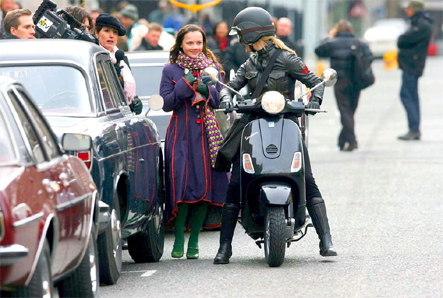
Penelope makes one friend after running away and living on her own. Resse Witherspoon (Sweet Home Alabama) plays the part of Annie who takes the scarfed Penelope on her vespa as she makes her deliveries so Penelope has a chance to see the sights she missed out on all her life. Even after Penelope's face is finally revealed, Annie still shares a friendship with the pig lady. I think this happens in our "real lives," too... it's not our Prince Charmings that always open our eyes or lead us into a new world... more often, it's our friends who are among the first people in all our lives to like us for who we actually are...
There are strands of cheap jokes (the buffoon blue blood and his clumsiness with the dwarfed reporter) and too-obvious use of computer graphics in this movie (a camera shot slides alongside a tree with falling autumn leaves)... but they work together to create a light-hearted tale. This movie is not trying to be anything other than what it is. You can pick it apart if it's attempting to be an epic romance, but it knows it's a family fairy tale and takes itself lightly while delivering lessons to be taken seriously.
But, for once (because this is almost always the part that makes me gag), the love story is what gets me the most...
The reporter mistakenly takes Johnny Martin as a high society blue blood and hires him to get into the Wilhern house to get his long awaited photo of Penelope. Johnny hears his price and takes him up on the job. When he goes into the house, he misses the preview of her face that the other men see (causing them, as usual, to run away). He stays in the room and waits. I really get a kick out of the device in this room...
 (from www.collider.com)
It's a two-way mirror on which Penelope's side is the one looking into the other room while all Johnny sees is his own reflection. Mics and speakers broadcast their voices into the rooms on both sides of the mirror. In reality, there's a distance we all tend to create when getting to know people and learning how to be ourselves with them... I think it's simple and clever. They sit right next to each other as they discuss music (the scene during which she's guessing what instrument he can play is just SO freaking CUTE), play chess, and talk about the things that Johnny does (and no longer does) in the outside world... but all through a boundary of glass. (One could go deeper and see how love both reflects our true nature as well as helps us to see ourselves in someone else, but, it's late, so, I won't take it that far.)
 (from http://z.about.com/d/movies)
Johnny has given up on life to gamble... the events leading to this lifestyle choice are unclear, but he shares this information with Penelope who, rather than pitying him, encourages him to get back to what he loves... music. After she unveils herself to him and comes to his side of the mirror, he is shocked, but he doesn't run. Unaccustomed to being stared at rather than shunned immediately, Penelope hastily retreats. He walks outdoors to the waiting reporter, smashes him camera, and tells him Penelope is not the monster others have fabled her to be and to leave her alone. When Penelope screws up her courage to talk to him asking him to marry her, he refuses, and she assumes the worse.
What's great about that idea is that he actually did not refuse because of her face. But because of her assumption, they part ways. She finds herself while running away, and he also rediscovers his need to play music and makes strides to get a gig again. Johnny quits gambling and negotiates with an old employer to come back to the playing hall. My Russian father used to tell me that relationships are in the best position for success if two complete people are coming together... if you are half-people, less than yourself and all that you are, something is missing when the agreement is made and the deal is liable to fall through. The lovers in this story repair the damage they've done to themselves and rejoin at the end. Johnny has a chance to tell her that he said, "No," because he was not a blue blood and, therefor, unable to break the curse. He wanted her to have what she wanted... and he thought that meant letting her go to marry some well-bred twit.
But we all have to break our own curses. No prince saved anyone in this story. Two people simply found a way to be themselves and to find someone who liked that version of who they were best of all.
This story is a reminder of all the things I learned as I got older and that I am perfectly comfortable passing down to the generations to come. Penelope was a book originally that I'll try to check out sometime soon to see if it's composed of the same "realness" that makes the pixie dust on this story sparkle...
 (from www.wildaboutmovies.com)
Sounds like a handful of fairy tales you've already heard of, right?
One reviewer said it was basically Cinderella meets The Ugly Duckling... and I guess he could be right. Thing is, I was never a huge fan of either story... maybe they needed each other to make a more interesting story.
Besides, the love that one witnesses in this story is not of the Oh-isn't-she-pretty-Can-I-keep-her, Disney sort of love like that of Sleeping Beauty, Snow White, or their precious Cinderella... it's a real love that acts out of wanting happiness for the other person...
...but I'll get to that.
The cast is terrific... but we all know that great actors don't make for a great movie all on their own (if you haven't seen the Anthony Hopkins' film about Kellogg... well... don't...). The irreplaceable and wide-eyed Christina Ricci (Addams Family) plays the part of Penelope and, one of my favorite crazy people, Catherine O'Hara (Best in Show) plays the part of her mother. Peter Dinklage (Chronicles of Narnia, Prince Caspian) portrays the sarcastic reporter out to capture the pig girl's image. And then, the love interest is played by one of my recently acquired favorite actors, James McAvoy (Atonement). There's nothing that needs to be said for these people... they all played their parts very well.
I appreciate this story for young girls. With all the crap that's out there for teenagers (Do not get me started on the new vampire craze) here's a simple story that I think holds true for most girls at one point or another. We've all had a day where we wanted to hide ourselves from the world... be it due to a bad perm (though your mother begged you to reconsider) or a wart, we have all wanted to avoid being seen, judged, ridiculed. Though this girl endured the pressure her whole life, that one flaw can seem like an eternity for a girl. I remember once in grade school (I must have been 7 or 8) I had a cold sore and my mother would not let me stay home from school... so I walked out of the house wearing a bandana... train-robber style... And you can bet your life I wore that ridiculous thing all day to hide the ugly thing from my peers.
Penelope has to learn to appreciate her looks (or moreover, all that makes her who she is) to break the curse. Though the curse the witch cries out in the beginning implies that the love debt must be repaid, Penelope and her family had the power to reverse the magic all along.
Her mother is a piece of work, though, and certainly does not help things. Mrs. Wilhern has been horrified since the day the pig child was born of how it changes her own way of social living. She works violently at concealing the girl... there's this heartbreaking scene where a little pig faced imp runs to the gates of her home where other kids are playing. Just as the kids approach to get a calm, closer look, the mother rushes out, scoops the girl up, and pries her hands off the gate by pulling her away. The mother teaches Penelope at home and makes certain she has a decent education, etiquette, etc. But Penelope never leaves the house, never interacts with people outside her immediate family, and check out this destructive mantra:
The real you is inside there somewhere just waiting to come out after the curse is broken.
Thanks, Mom.
Who needs Cinderella's wicked step-mother when you have a mother of your own to completely miss the point of her occupation. Trying so hard to correct her daughter's "ugly" situation, she never focused on who Penelope is as a person, what matters to her, what she wants to do with her life, etc. Of course, her mother realizes in the end that she could have broken the curse heraelf years ago... and while that sounds anti-climatic, I think that this is one of the most realistic scenarios I've ever seen in a fairy tale. Mothers in their zeal to protect their children can tend to forget that they really can't. You end up having to let go of your children and let them fight their own battles. The best one can do is instill in them a self-confidence, a self-respect to carry them through the trials of sharing their flaws with strangers and lovers alike.
(from myvespa.files.wordpress.com)There are strands of cheap jokes (the buffoon blue blood and his clumsiness with the dwarfed reporter) and too-obvious use of computer graphics in this movie (a camera shot slides alongside a tree with falling autumn leaves)... but they work together to create a light-hearted tale. This movie is not trying to be anything other than what it is. You can pick it apart if it's attempting to be an epic romance, but it knows it's a family fairy tale and takes itself lightly while delivering lessons to be taken seriously.
But, for once (because this is almost always the part that makes me gag), the love story is what gets me the most...
The reporter mistakenly takes Johnny Martin as a high society blue blood and hires him to get into the Wilhern house to get his long awaited photo of Penelope. Johnny hears his price and takes him up on the job. When he goes into the house, he misses the preview of her face that the other men see (causing them, as usual, to run away). He stays in the room and waits. I really get a kick out of the device in this room...
(from www.collider.com)(from http://z.about.com/d/movies)What's great about that idea is that he actually did not refuse because of her face. But because of her assumption, they part ways. She finds herself while running away, and he also rediscovers his need to play music and makes strides to get a gig again. Johnny quits gambling and negotiates with an old employer to come back to the playing hall. My Russian father used to tell me that relationships are in the best position for success if two complete people are coming together... if you are half-people, less than yourself and all that you are, something is missing when the agreement is made and the deal is liable to fall through. The lovers in this story repair the damage they've done to themselves and rejoin at the end. Johnny has a chance to tell her that he said, "No," because he was not a blue blood and, therefor, unable to break the curse. He wanted her to have what she wanted... and he thought that meant letting her go to marry some well-bred twit.
But we all have to break our own curses. No prince saved anyone in this story. Two people simply found a way to be themselves and to find someone who liked that version of who they were best of all.
This story is a reminder of all the things I learned as I got older and that I am perfectly comfortable passing down to the generations to come. Penelope was a book originally that I'll try to check out sometime soon to see if it's composed of the same "realness" that makes the pixie dust on this story sparkle...

No comments:
Post a Comment